

| Article type | Research article | 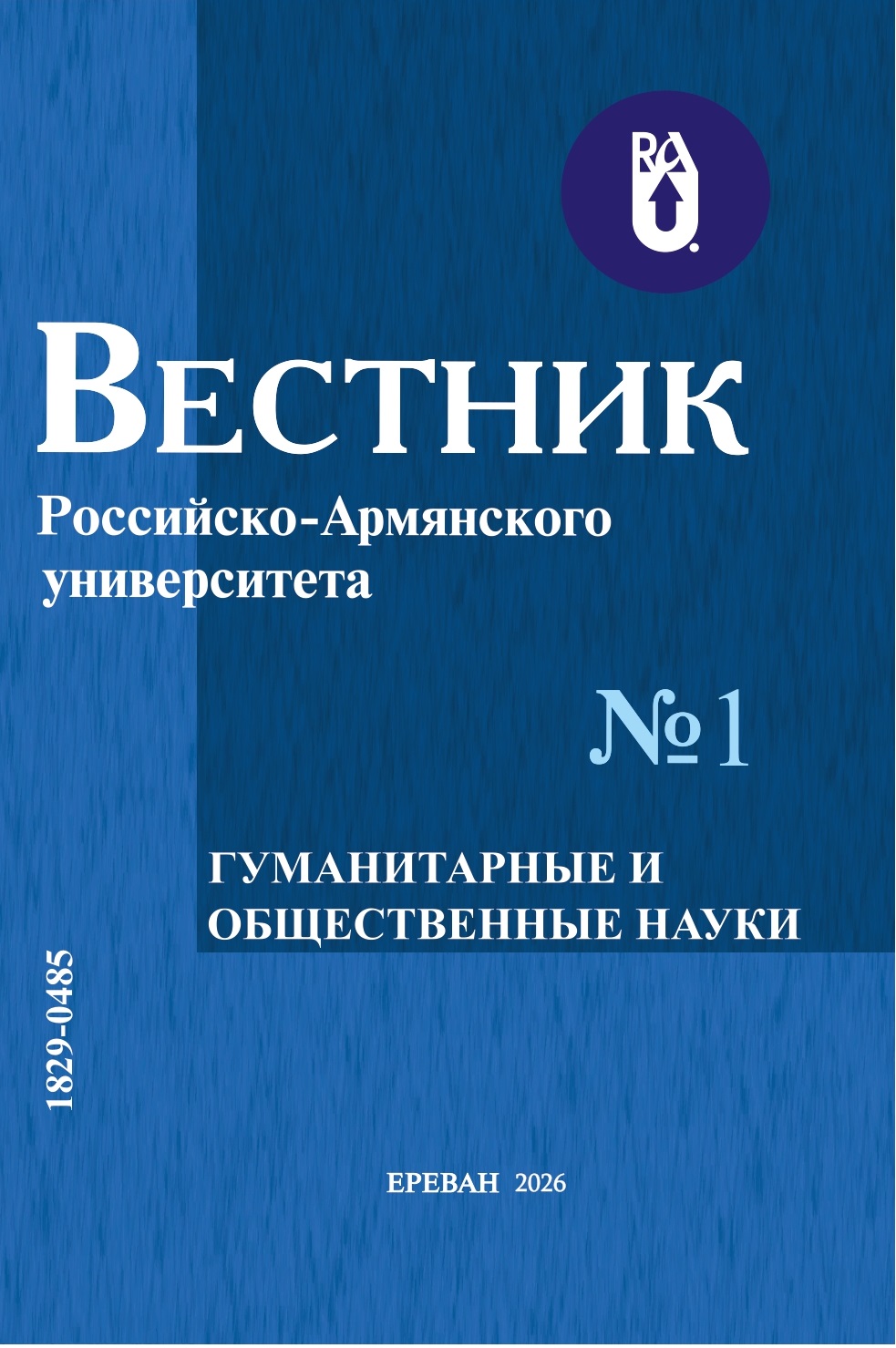 |
| Year | 2026 | |
| Author(s) | Rostomyan Zh. | |
| Journal title | Vestnik of Russian-Armenian University (series: humanities and social sciences) | |
| Issue | 1 | |
| Pages | 235-249 | |
| Publication format | ||
| DOI | 10.24412/1829-0485-2026-1-235-249 |
ABSTRACT
The course for teaching Armenian as a foreign language is conducted through several stages: first, speaking, then oral reproduction, literacy and written composition, acquisition of reading skills, and mastery of basic grammatical knowledge. In each of these stages, both traditional and innovative methods are applied simultaneously – more precisely, they are often combined and sometimes even fused. For example, during the teaching of oral speech and vocabulary enrichment, the process begins with mastering words and expressions necessary for everyday communication (forms of greeting and farewell, introducing oneself to a conversation partner, asking questions during a first meeting and being able to respond to them). This approach is also widely accepted in traditional language teaching methods. After one or two lessons, when the learner’s speech range has somewhat
expanded, the communicative approach supports the acquisition of oral speech. This involves the practical use of language in real-life situations and contributes to the development of speaking skills. In this phase, dialogues (especially student-to-student formats) and then polylogues (multiperson conversations) are emphasized. These are components of every oral speech lesson, but each new lesson also incorporates other innovative methods and technologies – for example, performing oral tasks individually, in groups, or in team-based formats. This approach is applied throughout all stages. In the process of teaching Armenian as a foreign language, it is essential
to use both traditional and innovative methods and technologies. These complement and harmonize with each other, and thanks to this diversity, the learning process becomes more accessible, more engaging (from the student’s perspective), and encourages deeper exploration – making it more effective overall.
Keywords: traditional and innovative methods, the communicative skills, interactive method, dialogues, polylodes, teaching the oral speech, writing and easy grammary.
REFERENCES
Gyulamiryan J. Methodology of teaching the native language, Yer.: “Zangak”, 2018, 420p. P. 112. (In Arm.)
Passov E. Fundamentals of communicative methods of teaching foreign language communication, M., 1989. 276 p. P. 195. (In Russ.)
Lado R., Fries Charles C. English Pattern Practices, Michigan, 1958, 338p. P. 14.
Berman I., Bukhinder V., Plakhotnik V., Pol L., Strauss V. Fundamentals of methods of teaching foreign languages, Kyiv, 1986, 325p. P. 165. (In Russ.)
Vygotsky L. Thinking and Speech, M., 1982,361 p. P. 121. (In Russ.)
Avagyan M. Thoughts on the native language, Yer.: “Arevik”, 1988, 178p. P. 6. (In Arm.)